Shih-Fang Chen

Hello, I'm Shih-Fang Chen

I hold a Ph.D. in Computer Science, specializing in machine learning and computer vision, with a research focus on adaptive visual and video perception and improving model robustness and generalization in complex, dynamic environments. My research aims to bridge the gap between human and machine visual intelligence in dynamic, real-world environments.

I develop novel learning methods for robust visual perception, spanning multimodal learning, foundation model adaptation, and test-time adaptation. My expertise combines original algorithmic research with hands-on ML engineering, including model development, pretraining, fine-tuning, optimization, and large-scale evaluation.

My recent research has led to three first-author publications in top-tier ML/CV conferences and journals (ICLR 2026, IEEE TCSVT 2026, and IEEE TMM 2025), along with open-source models and code. I have also received multiple academic honors, including recognition for my doctoral dissertation. Before pursuing my Ph.D., I designed vision algorithms to address real-world industrial challenges and collaborated with industry partners to deploy these solutions, contributing to granted invention patents.

I'm seeking Research Scientist, Applied Scientist, and ML/CV Engineering opportunities to advance AI research and build innovative solutions with real-world impact.

Research Areas & Interests

Visual/Video Perception, Multimodal AI, Video Understanding, Spatial Intelligence, Foundation Model Adaptation, Model Training and Optimization, Test-Time Adaptation, World Models

Doctoral Research

Human visual perception lies in the ability to maintain a continuous and coherent understanding of the external world by integrating observations with accumulated experience. The human visual system continuously adapts to changes in targets and environments by leveraging prior knowledge, spatial geometry, and semantic context. As a core problem in computer vision, visual object tracking aims to bring machine perception closer to human visual perception.

Browse slides

Generic Object Tracking (GOT) aims to continuously localize an arbitrarily specified target in dynamic visual streams. However, unpredictable target and environmental variations make generalization and test-time adaptation key bottlenecks, particularly under severe deformation, complex distractors, environmental changes, and unseen target categories.

This dissertation aims to narrow the gap between machine visual tracking and human visual perception by proposing a series of ML methods that systematically enhance target discrimination, robust adaptation, and geometric reasoning capabilities.

Peer Review Service

Reviewed 50+ manuscripts for the following venues:

Selected First-Author Publications & Patents

Google Scholar

GOT-Edit

Shih-Fang Chen, Jun-Cheng Chen, I-Hong Jhuo, Yen-Yu Lin

International Conference on Learning Representations (ICLR 2026)

Designed a novel multimodal learning framework enabling safer and more reliable cross-modal test-time adaptation of video perception models to enhance spatial intelligence and adaptability in complex and dynamic environments via an innovative test-time model editing approach that integrates 3D visual geometry (VGGT/DA3) and 2D semantics (DINO).

GOT-JEPA

Shih-Fang Chen, Jun-Cheng Chen, I-Hong Jhuo, Yen-Yu Lin

IEEE Transactions on Circuits and Systems for Video Technology (TCSVT 2026)

Designed a self-supervised pretraining framework that extends JEPA to predict neural network parameters for test-time model adaptation, improving generalization to unseen targets and dynamic environments; incorporated point tracking to support object-level adaptation and improve long-term visual tracking robustness under occlusions.

PiVOT

Shih-Fang Chen, Jun-Cheng Chen, I-Hong Jhuo, Yen-Yu Lin

IEEE Transactions on Multimedia (TMM 2025)

Designed an automated visual prompting framework for adaptive target–distractor discrimination at test time, enabling cross-model collaboration between CLIP and the tracker to dynamically leverage zero-shot contrastive knowledge for robust tracking in dynamic environments.

Intelligent Logistics Data Collection System

Taiwan patents (2022, 2023) · Invention application publication and grant

Developed and deployed an industrial computer vision system using image restoration and semantic segmentation for stacked-substrate measurement, automating manual inspection and reducing annual operating costs.

Selected Fellowships, Scholarships & Honors

Research Slides

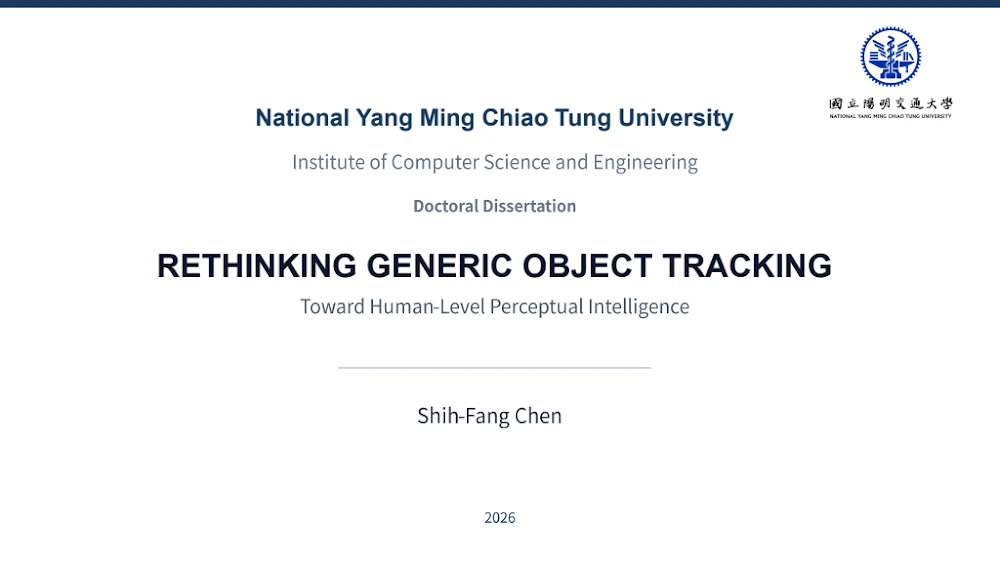
Rethinking Generic Object Tracking Toward Human-Level Perceptual Intelligence

Rethinking Generic Object Tracking — research slide cover

Browse the slides here, or open the full-size viewer.

Recent Work Experience

2021–2026

Machine Learning & Computer Vision Researcher

NYCU / Academia Sinica · Doctoral research fellowship

  • Led ML R&D of visual/video perception systems, identifying and addressing key visual tracking challenges to improve model robustness, generalization, and adaptability in complex, dynamic environments
    • GOT-Edit: Designed a multimodal learning framework for safer and more reliable cross-modal test-time adaptation of video perception models through model editing, integrating 3D visual geometry (VGGT/DA3) with 2D semantics (DINO) to enhance spatial intelligence and adaptability
    • GOT-JEPA: Developed a self-supervised pretraining framework extending JEPA to dynamically predict model parameters for test-time adaptation, improving generalization to unseen targets and environments. Used point tracking for pixel-to-object-level visibility reasoning to improve long-term tracking under occlusion
    • PiVOT: Designed an automated visual prompting framework for adaptive target–distractor discrimination at test time, enabling cross-model collaboration between CLIP and the tracker to dynamically use zero-shot contrastive knowledge
  • Built and optimized ML training pipelines for 20M+ video samples and million- to billion-parameter vision models. Optimized training and inference through architecture design, DDP/DeepSpeed, mixed precision, activation checkpointing, PEFT, and periodic KV cache updates
  • Consistently achieved state-of-the-art tracking performance and strong generalization to unseen and complex environments across studies, validated on 1M+ samples across 7 benchmarks under diverse visual conditions
  • Published three first-author papers at ICLR 2026, IEEE TCSVT 2026, and IEEE TMM 2025 as the sole student author. Open-sourced models and code and drove weekly technical discussions with academic and Microsoft AI researchers to review experimental findings and refine research approaches
2020–2021

Machine Learning & CV Researcher (Full-time RA)

Yuan Ze University · Full-time

  • Led the development of computer vision algorithms for edge AI systems as the sole vision-system developer, with applications including 3D interaction, pose estimation, and motion analysis. Delivered vision solutions to industry partners and contributed to research publications
2018–2020

Computer Vision Researcher and Engineer (M.S.)

Yuan Ze University · Master's industry–academia research

  • Owned industrial computer vision system development in an industry–academia collaboration, translating partner requirements into a research prototype and a production-ready system
  • Designed a vision system for PCB stacked-substrate counting using image restoration and segmentation, automating manual inspection, reducing annual operating costs, and contributing to patents
more

Technical Skills

Let's connect